This blog posts builds on an article I wrote for theNBS.com - Specifications and classifications
https://www.thenbs.com/knowledge/specifications-and-classification
There are a number of use cases for classify assets/things, for example:
- An annotation on a drawing or schedule;
- A clause reference in a specification;
- A Category code in a COBie spreadsheet; or even
- A label on a physical product
In the UK, the two most common classification systems are Uniclass 1997 (in particular Table L aka Common Arrangement of Work Sections aka CAWS) and Uniclass 2015.
The need to develop Uniclass 2015 to meet the demands of a digitalized construction industry is detailed at the web page below:
But with roughly half of the industry choosing CAWS and half choosing Uniclass 2015, the question often arises, do they map? and if so how?
In our latest release of NBS Source, all manufacturer systems and products with specifications information now have both Uniclass 2015 codes and CAWS codes.
Some examples below showing the mapping. Starting with a simple examples and then gradually showing more complex examples.
1. Simple example
One of the aims behind the Uniclass 2015 project was to have a single classification to represent each 'thing' in the built environment. So one classification for a Secondary School (Co_25_10_77) down to one classification for an Interactive Whiteboard (Pr_40_30_25_42).
So in CAWS, is it the same and there is a nice one to one mapping?
Not quite, but almost so in the most simple examples. Consider a daylight pipe.
Source example - https://nbs.fyi/M8wKaK
 |
| Simple example - Daylight Pipe |
There is a one-to-one mapping between Pr_30_59_72_21 Daylight pipes and L10/495 Daylight pipe.
Moving up a level in the tree L10 groups Windows/ rooflights/ screens/ louvres and Pr_30_59_72 groups Rooflights with Pr_30_59 grouping all Openings and opening component products.
By clicking on the classification reference in Source then similar products may be viewed.
- Rooflights filtered to show only daylight pipes
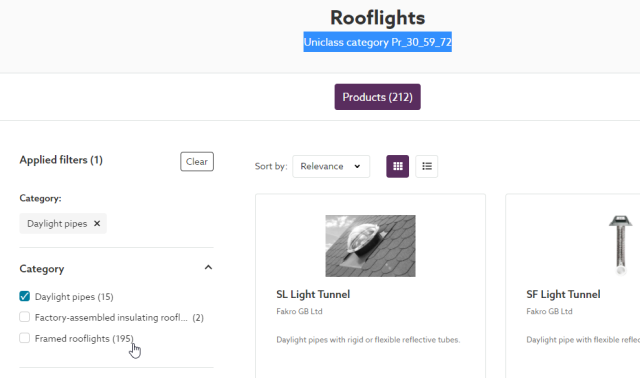 |
| Grouping different types of rooflights together |
But this is a one-to-two mapping! What is L10/52 Daylight pipes?
This is the simplified clause in L10 used in the Small Works library. For legacy reasons, there are many products with multiple CAWS references with a specification clause for more complex work and one for more simple work.
2. Not quite as simple example
The second example is a concrete roof tile.
Source example: https://nbs.fyi/awY4MC
 |
| Not quite as simple - a concrete roof tile |
In this example, Uniclass 2015 is simple - one code for one physical product. But CAWS unfortunately has a clause for concrete roof tiling and another one for concrete roof tiling with counterbattens. Then, in addition, there are small works versions of both of these.
So analysing 'big data' across many projects with CAWS would need a look up of for four codes.
With Uniclass 2015, a client need look up just one.
Again, the parent groupings allow similar products to be quickly viewed.
View concrete interlocking tiles within the parent category of roof and cladding units
3. Complex example
The most complex example can be seen with products that can be used with many systems. The way CAWS references evolved over time means that there can be a huge number of relevant reference codes. However, with Uniclass 2015 there is only a single code in the majority of cases.
In this final example we will look at lime mortar
Source example: https://nbs.fyi/IW6SQo
 |
| Complex example - one to many |
When the CAWS content was developed, computers were barely used and we lived in a paper world. Now we have modelling tools that can create a link between a parent system and a child product (such as NBS Chorus) or a parent space and a child system (such as Archicad/Revit). So each thing can have a single code and the modelling tool can digitally give the context.
The screenshots below shows one type of lime mortar being used by two different systems. But specified once. By specifying once it makes procurement easier and when potentially defending specification decisions gives context. For clients that want build a digital estate - it makes data querying achievable.
 |
| Masonry system A linking to the mortar product |
 |
| Masonry system B linking to the same mortar product |
 |
| The product specified once - but with clear context shown |
To view the mappings, explore NBS Source (free-to-industry):
- https://source.thenbs.com/
To specify to the Uniclass 2015 structure, CAWS structure use NBS Chorus (subscription):
- https://www.thenbs.com/nbs-chorus
To watch a video to learn more about NBS offerings - click below:
- NBS in 60 seconds
- NBS in 30 minutes


