Wednesday, 23 September 2015

NBS event - BIM for manufacturers

We held an event yesterday for prospect businesses with a view to showcasing our business and our expertise in BIM. This blog post highlights some of the key messages and also some of the insight we received through asking the delegates their opinions. The speakers were largely from NBS giving different insights from their areas of expertise.

Rather than a big waffley blog post – I just include some of the slides and a little bit of commentary.

1. Richard Waterhouse – CEO
Richard gave a strategic overview as to what BIM is, what it means for the industry and how NBS can support construction manufacturers on their journey.

Every seat filled on the top floor of Millbank Tower
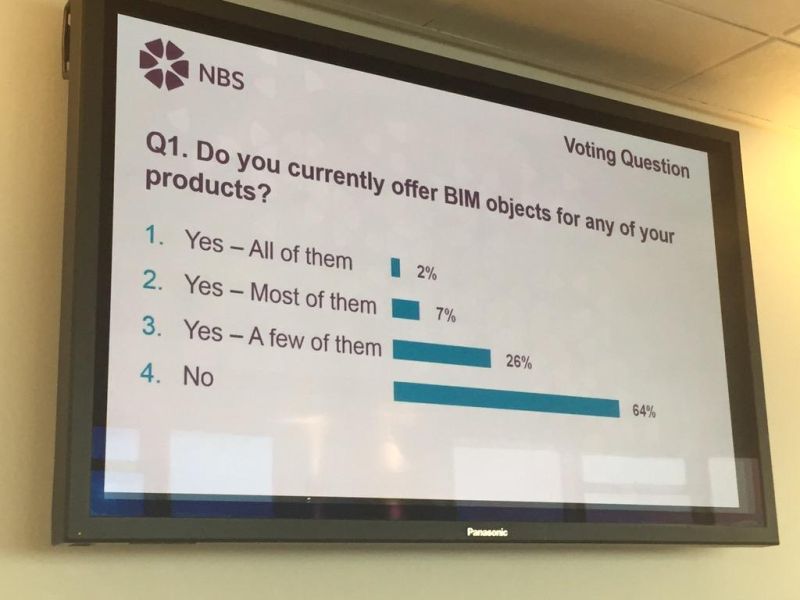
Still a long way to go in terms of manufacturers and BIM object creation
The NBS BIM ecosystem – coordinating well-structured information
2. Adrian Malleson – Head of forecasting and research
Regular visitors to the blog will know Adrian from the excellent work he has done over the years with the National BIM Report. Adrian’s team at NBS do far more than just this BIM report though and today he gave an insight into the external factors that influence our industry. The financial situation, sustainability and urbanisation challenges and disruptive technology where all looked at.

The industry is currently in a good place
Quite a lot of new buildings will be needed across the world
More evidence that the manufacturer community is largely not ready for the demands of BIM
To learn more about the Market Research opportunities at NBS - please visit:
http://www.riba-insight.com/products/market-research.asp

3. Tom Murphy – David Miller Architects
To give the view of a construction professional independent of NBS, Tom Murphy from David Miller Architects kindly came and demonstrated how a small practice’s BIM process works.

BIM training and software is inexpensive when compared with costs and the fees that can come in
The NBS National BIM Library can be used as a model evolves from using generic to proprietary objects
The NBS National BIM Library can be relied upon for quality information rich objects
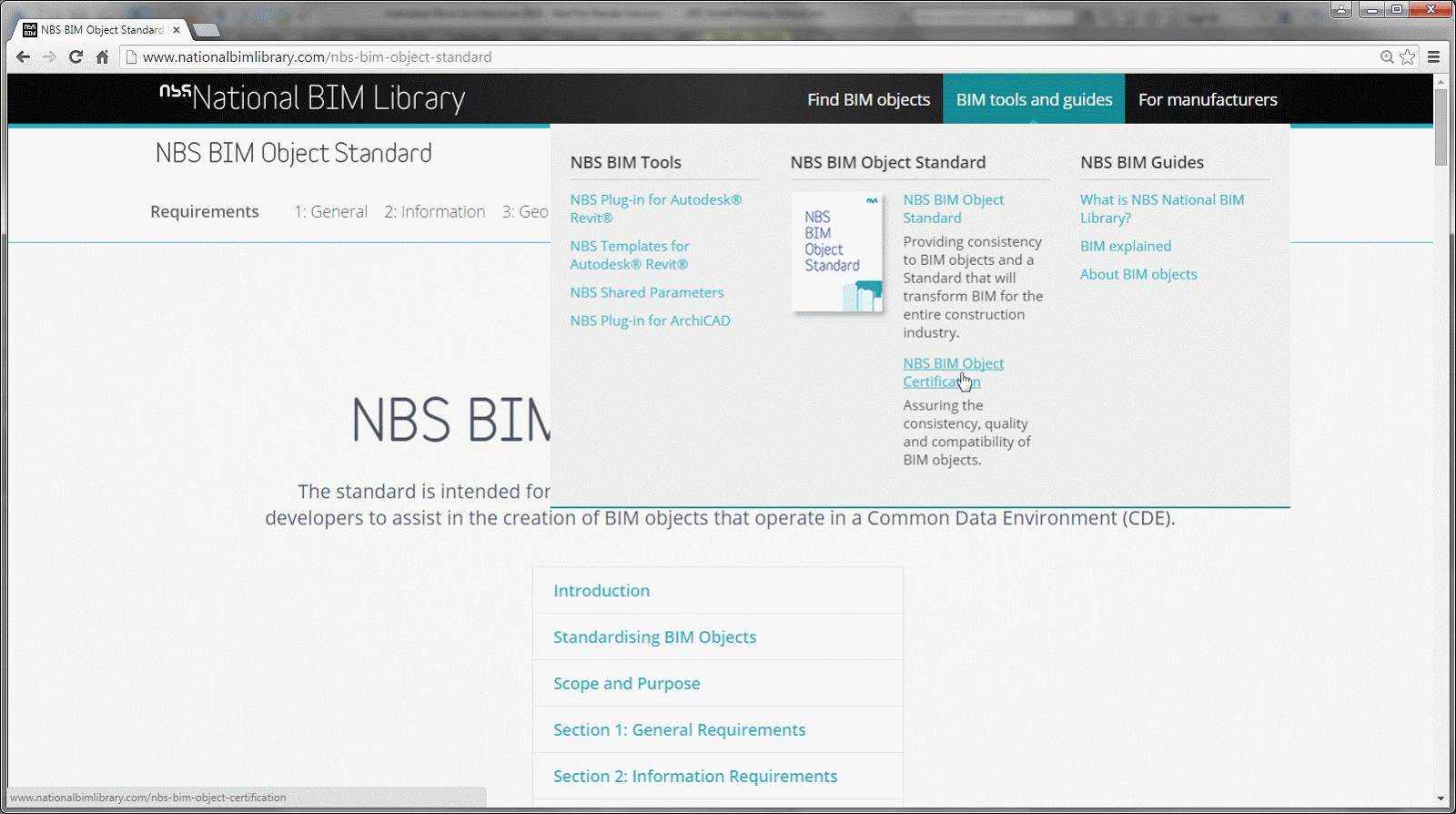
Certification against the NBS BIM Object Standard gives an assurance of quality
Using the NBS BIM plug-in allows the model and the NBS Create specification to be coordinated
4. Live demonstrations – Ian Chapman, Drew Wiggett and Chris Vickers
The delegates were then split into two groups. Ian Chapman took a group wanting a beginners introduction into BIM. Drew Wiggett and Chris Vickers presented some more advanced topics to those already on their BIM journey.
A beautiful venue with the Millennium Wheel in the background
Cheesegrater, Gherkin, Shard and Ian Chapman
How to create objects to the NBS BIM Object Standard
5. Me
Moving on, I then presented the BIM Toolkit and in particular how manufacturers can best provide their technical data to the project team working on level-2 BIM projects.

As time was a little tight, I focused around the Level of Detail (LOD) and Level of Information (LOI) guidance and how they can be referenced within a digital plan of work.

LOD guidance for building fabric and building services items
LOI guidance for building fabric and building services items
A nostalgic look at the inefficient ways that information used to be developed and transported
The argument is over now – the traditional methods are dead and digital is here to stay
Digital information in different formats from manufacturers is needed throughout the project timeline
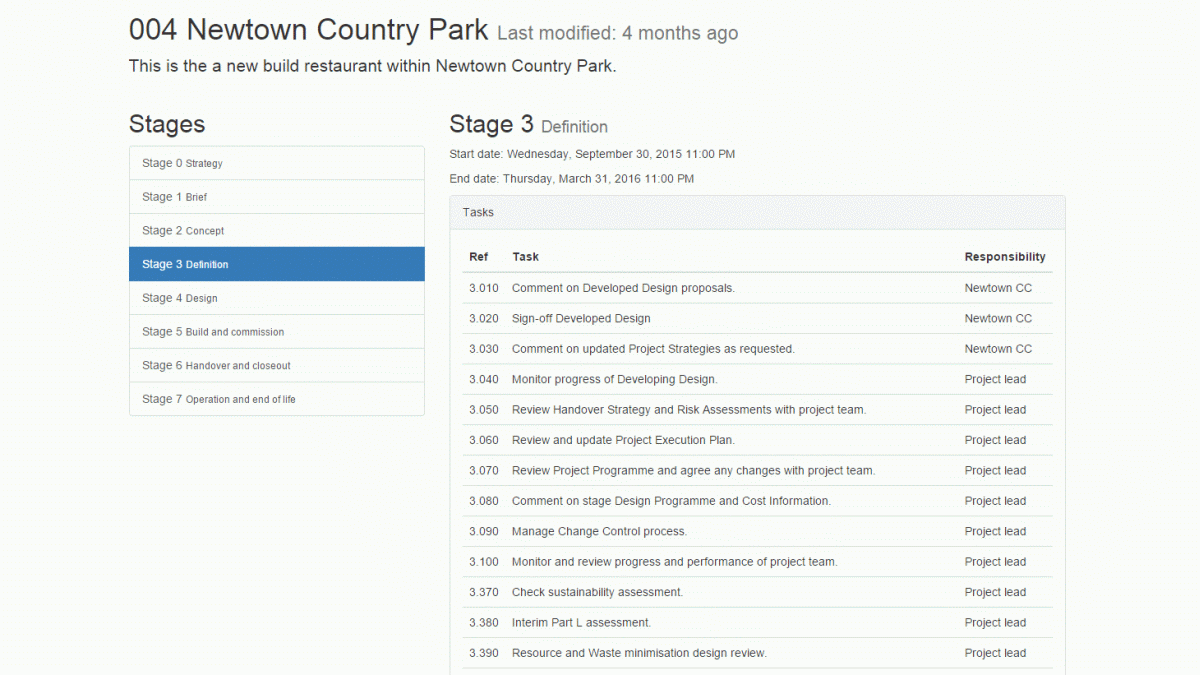
The BIM Toolkit presents the correct information at the right time to the correct person  - NBS manufacturer customers are positioned in an optimum position on the page
6. Robin Cordy – Director of Digital
A BIM object is one way that a manufacturer can deliver greater value to their engineering or architectural ‘customer’. But how do they know that creating BIM objects provides a return on investment?

Robin Cordy, Director of Digital at NBS is a specialist in digital commerce, below are a few slides from him.

Know what metrics that will show things are working
Five steps to success
Maximise the exposure of your content in the products and services that the decision makers use
One final speaker was Fiona Cruickshank who is a Entrepreneur and Angel Investor. I always like to hear from those who have had success in other industries and how clear parallels can be seen.

Fiona talked about the pharmaceutical manufacturing industry and in particular how new legislation and disruptive change can be the best business opportunity. If you are fast to react, prepared to take calculated risks and invest a little then the rewards can be enormous.

Fiona had built up a number of businesses and had invested in many others and was an inspirational speaker to have at the event.

For manufacturers reading this blog who want to know more about how NBS can digitally connect you to construction professionals please see:
- http://www.nationalbimlibrary.com/bim-for-manufacturers

Tuesday, 22 September 2015

BIM Toolkit API for software developers

When setting out to work on the BIM Toolkit we wanted to make this a truly digital project. Where organisations with software development skills wanted to work with the data then we wanted to make this as easy as possible. As a result, the LOD, LOI and Uniclass 2015 classification library information have all been published digitally on the cloud and can be accessed using documented web API calls.

This blog post builds on some of the information that is already available in the article The BIM Toolkit for Software Developers in the support area of the website.

The sample applications below are deliberately as simple as possible. This is to help those with software development skills quickly understand the code so that they can then then develop more complex solutions.

The first sample I’d like to look at is one that can easily be worked with in a development environment that is already installed on most machines – the Visual Basic environment within Microsoft Excel.

The screenshots below show that the LOD, LOI and classification information can be worked with providing the user has a web connection.
Fig 1 – From a classification code and an LOD banding, the LOD guidance can be displayed
Fig 2 – From a classification code and an LOI banding, the LOI guidance can be displayed
Fig 3 – From a classification code and an LOI banding, the LOI property sets can be returned
Fig 4 – From a classification code, child or sibling classifications can be returned
Fig 5 – Stepping through the client code in Visual Basic (in this particular sample)
The support page written by NBS Labs Manager Alan Smith can be found in the support area of the BIM Toolkit website. Details on how to sign up for API access are provided on this page. There are also a number of samples (including the Microsoft Excel sample) on the NBS github page.


Fig 6 – Support for software developers from NBS
Fig 7 – The NBS github page
Fig 8 – A .Net web sample showing how to work with a digital plan of work file exported from the Toolkit
Fig 9 – A .Net windows application from the recent AEC Hackathon importing a digital plan of work file
Fig 10 – A .Net web sample showing how to work with the Uniclass 2015 classification system
Fig 10 – A .Net web sample showing how to embed LOD and LOI guidance within a website
...and finally, a snapshot of each stage can also be exported to COBie and IFC format to comply with the UK level-2 BIM standards for information exchange.

The documentation for these standards are below. We recommend the BIM Academy xBIM SDK for working with both COBie and IFC pro grammatically.

Fig 11 - Export to COBie or IFC

Friday, 11 September 2015

NBS Create and BIM

Yesterday I was in London with a number of large architectural practices who have been NBS users for many years. As part of this session we looked at how NBS Create can work within a BIM environment.

As always with live demonstrations, it's always a good idea to take screenshots in case the technology doesn't work on the day - so I thought I'd blog these screenshots here as they may be of interest to others.
(All images can be clicked on to make them bigger).

Figures 1 and 2 below show how an NBS specification can be linked to a Revit model so that the user can quickly view the specification for a system or a product without taking up an NBS licence. Within the NBS viewer all hyperlinks to clauses and external standards may be clicked and sub-sections can be expanded and collapsed.
Fig 1 - Select an object to view the specification
Fig 2 - The specification is accessed in the viewer
Figures 3 and 4 below demonstrate how annotations may be quickly added. When any linkage is broken, the user may correct this through the NBS plug-in functionality.

Fig 3 - Report on incorrect annotations
Fig 4 - Correct the annotations by selecting the appropriate clause from the specification
For those needing to access the NBS design guidance, this also may viewed in a single click. In the example below the user is considering the security guidance with respect to doorsets from the context of the model.
Fig 5 - NBS design guidance from the context of the model
To learn more about the free NBS plug-ins for BIM platforms (Revit, ArchiCAD, Vectorworks) please visit - http://www.nationalbimlibrary.com/bim-tools-and-guides

Following the demonstration on specification and model linkage we then looked at the standardised content that is available free from the National BIM Library. The screenshots below show how objects can be dragged and dropped directly from the National BIM Library into a model and how the objects synchronise with the guidance and notes on the web.

In addition to the development of generic objects to manufacturer and the specification linkage, the other big benefit of using National BIM Library is the consistency and quality of the information within the objects. The screenshots below show how the IFC, COBie and NBS properties are consistently authored to the NBS BIM Object Standard. This gives assurances of quality to any end-user or manufacturer using the library.

Fig 6 - Technical guidance on the web for the objects in your model
Fig 7 - Consistent IFC properties authored to the NBS BIM Object Standard
Fig 8 - Content from almost 200 manufacturers all authored to the same standard
Fig 9 - Property sets showing standard international definitions
Fig 10 - Pragmatic levels of geometric detail in the objects to keep the file sizes to an acceptable level.
The NBS BIM Object Standard is a free PDF download and also a website with associated guidance. It's great to see so much manufacturer content to this standard and more and more design practices adopting this standard for their own internal use. The screenshots below show a little from the standard website.
http://www.nationalbimlibrary.com/nbs-bim-object-standard
Fig 11 - NBS BIM Object Standard 
Fig 12 - Free-to-use standard and associated guidance

Friday, 4 September 2015

Standardised BIM objects for the UK, Australia and New Zealand

Earlier this week it was announced that the NBS BIM Object Standard was going to be established in both Australia and New Zealand.
http://www.bimplus.co.uk/news/nbs-help-establish-bim-object-standards-australia-/


It is fantastic to see this initiative take off in the way that it has. All manufacturer content on NBS National BIM Library is now certified to this standard. Revising such a huge amount of content (tens of thousands of objects from 180+ manufacturers) to standardise it all is what makes the NBS library unique. With the library expected to rise to over 200 manufacturers by the Autumn this is great news for the industry who are benefiting from this free content.

NATSPEC in Australia and MasterSpec in New Zealand have recognised the benefits that a standardised method of creating content brings.

However, it may be worth taking a few moments to reflect, why is standardised content important?

It may be worth reading Director of National BIM Library Ian Chapman's article in the latest NBS BIM Report, but here are some views from me...

Firstly, it is worth looking outside of the construction industry. If you buy a car you know that the nozzle from each petrol station will fit due to having standardised fittings. If a property from an estate agent is to appear on RightMove the data must be in a standard format.

The huge benefits here for end users are (a) an assurance that what they are receiving has a set level of quality and (b) the information will be consistent every time they interact with the service.

If the automobile industry didn't have standards for fuel nozzles then it would grind to a halt (literally). If RightMove didn't have a standard structure for their data then they would not have the success they have had as users wouldn't be able to consistently query the information. This base level of standardisation allows car manufacturers or estate agents to compete purely on the value of their product.

Equally, a trusted BIM library needs a standard for its content. Arguably, if it is simply the geometry that is important, then maybe a standard is less important. But if it is the 'I' (information) in BIM that is important then consistency across this information is vital.

Two examples below...

1. Doorsets
Two doorsets below, from different manufacturers author, are both to the NBS BIM Object Standard. Referencing Section 2 Information Requirements of the standard it can be seen that they have consistent Property Groupings. The international standard IFC property grouping Pset_DoorCommon has been expanded and it can be seen that it is immediately clear whether the door can be used as a fire exit, what it's fire rating is and also what the acoustic rating is.


2. Heating products
In the example below, the NBS_Data property grouping has been expanded to show the consistency in terminology between two different heating products. Both the Radiator and the Fan Convector have some properties in common and some that are different. However, those that they have in common are consistent. These properties that go further than the IFC or the COBie property groupings and are written for the UK can be found and used by the industry at the BIM Toolkit website which contains over 5,700 of these definitions.
So fantastic news that the NBS BIM Object Standard is getting such international recognition and commitment. Users of the library now know that whichever object they download will contain consistent information. Considering that there are over 150 manufacturers now on the library, I think that is an achievement to be proud of.

The standard has been written specifically for the NBS National BIM Library but it is of course available to be used freely by any other organisation (contractors, clients, architects, engineers, manufacturers) who creates BIM objects and would like consistency of content with the NBS library.

Thursday, 13 August 2015

AEC Hackathon - London

At NBS, we recently supported and took part in the first ever AEC Hackathon in the UK.


NBS Labs Manager Alan Smith (@AlanSmithNBS), who has led software development projects for over ten years at NBS writes this guest blog on the event below.

Alan writes...
NBS Alan


I was really excited to be invited to the first AEC Hackathon outside of the US, held at the Future Cities Catapult’s Urban Innovation Centre in London. I was invited to the event to present the BIM Toolkit along with my NBS colleagues Chris and Matthew. NBS also set a challenge for the event. Having never been to a hackathon before I wasn’t sure what to expect.

Day one: Friday 17th July – 6-10PM
After registering we were well fed and given time to look around the fantastic venue that would be our home for the next 48 hours. The hosts for the Hackathon were Paul Doherty (AEC Hackathon co-founder) and Simon Hart (InnovateUK). Paul went over the structure of the next few days and then Damon Hernandez (AEC Hackathon co-founder) appeared on a video wall from his home in San Francisco to explain the purpose of the AEC Hackathons.

At the end of his introduction, Damon donned a construction hard hat and so began the “Lighting rounds”. The lighting rounds were an opportunity for people to introduce themselves, their skill set and challenges they want to work on. There was a real mix of backgrounds – software development, architecture, mechanical engineering etc.

Paul Dougherty kicks of the first AEC Hackathon outside of the US
Day two: Saturday 18th July – 8AM-11PM
The NBS Team wanted to see what they could do with Autodesk’s Large Model Viewer API and data from the BIM Toolkit, so we set about planning our development work. Other teams started forming and hacking commenced.
NBS team hard at work
For those not taking part in the Hack challenges, there were some fantastic presentations throughout the day from Simon Hart, Rick Holland and Jonny Voon of InnovateUK, Damon Hernandez, George Stevenson and Tim Aikin of ActivePlan, Su Butcher of Just Practising Ltd, Grzegorz Klimaszewski of AssetMapping and more.
Rich Holland predicts the future of Smart Cities and IoT
And of course, I gave a presentation on the BIM Toolkit.
BIM Toolkit presentation
Meanwhile, the NBS team had made steps forward in exporting data from the BIM Toolkit in to our NBS Cost Tracking tool to show how toolkit data can be used to help with tendering and cost tracking. We’d also looked at using the  Large Model Viewer API from Autodesk to render National BIM Library objects in the web browser to help users inspect and review an object prior to downloading it.
Deliverables in the BIM Toolkit
Transferring the data into another software application
The BIM Toolkit data now being used in a cost tracking package
Experimenting with APIs that were available over the weekend from other software vendors

Interrogating IFC through the webbrowser
The day ended with everyone looking very bleary eyed but there was a huge buzz in the room and expectations were high for the presentations on Sunday.

Day three: Sunday 19th July – 8AM-1PM
Final hours of hacking were frantic running up to the presentations at lunchtime. I was blown away by the quality (and amount of work) of the work that had been achieved in such a short time. 

The first team to present were Optioneers, who focused on the challenge to help clients make better choices when they buy a house – so they can see the cost and carbon impact of having a flat vs a raised roof etc. Optioneers won the prize for the best use of open source.

Next up were Gapath0n, who created an open API to improve analysis of an Innovate UK and Energy Savings Trust dataset evaluating the performance of dozens of buildings. The team won three awards for their efforts: the Innovate UK Hack challenge, the Energy Saving Trust Challenge and the Future Cities Catapult Challenge.

Next to present were GhostBIMSquad. The team started with a demonstration of using Autodesk’s Large Model Viewer API to view a hospital. Then team then unleased feature after feature of additional things they had worked on from asset tagging to suggest suitable substitute products from a product selection database, Bluetooth navigation to locate assets within the building and finishing with a “hacked” together Perspex box that could display a hologram of the building. The team won Best Overall Project and the Autodesk VR and 3D Challenge.

Trying to top the last presentation were, team Massive. Massive created an impressive 3D app using ordinance survey data to identify potential redevelopment in London, with a view to creating more space in the city by identifying buildings that could be raised in height based on planning permission granted to surrounding buildings. Massive won the NBS prize for the best use of BIM.

The presentations were concluded by team Concur, who created an app using Autodesk’s Large Model Viewer API to provide project teams and clients with a method of commenting and feeding back on designs.

Summary
I entered the AEC Hackathon in London not knowing what to expect – the image I had in my head was like a scene from the movie Social Network. Fortunately this wasn’t quite how it panned out. Simon Hart and Paul Doherty did an excellent job organising the event in London and there were some really impressive hacks and some brilliant presentations and inspiring speakers that you’d pay a lot of more to see at a conference. It was also an excellent opportunity to meet like-minded people within the AEC Sector. The event was such a success that it tended #3 in the UK on twitter and Damon Hernandez has confirmed there will be another AEC Hackathon in London summer 2016.

This review of the AEC Hackathon was written by Alan Smith, NBS Labs Manager

Other reviews of the event (as kindly collated by Simon from Innovate UK) are below:

Tuesday, 4 August 2015

BIM Report for Manufacturers

 A week or two ago we published our NBS National BIM Report for Manufacturers 2015.

It has contributions from our Chief Executive Richard Waterhouse and Director of National BIM Library Ian Chapman. In addition, Head of Research Adrian Malleson looks at the 2015 BIM survey from the perspective of a manufacturer.


There is a short case study from architectural practice, David Miller Architects outlining how they have integrated BIM throughout their design processes. A particular focus is on how they use well-structured manufacturer information to create greater efficiencies and added value to their clients.

David Miller comments on the importance of quality when it comes to BIM objects, "Knowing that
information has been developed to the NBS BIM Object Standard will give us the confidence
we require".


There are also two case studies from manufacturers who have been early-adopters of BIM.

Assa Abloy Managing Director of UK Specification David Wigglesworth comments, "It is fair to assume that the 2016 mandate for government-funded projects to use BIM will have a significant impact on its uptake and use in the construction industry, with manufacturers supplying to public sector builds seeing BIM as a ‘must-have’".

Joris Smet Director at Smet Building Products Ltd comments, "Moving into our third BIM year, in alignment with our strategy, we will continue to prioritise monitoring designers’ needs, invest in, and
enhance, our BIM catalogue and continue to address the immediate need of designers for access to high quality, standardised, information-rich BIM objects. This is a distinct opportunity and we will continue to do more in collaboration with NBS – in whom designers trust – to ultimately strengthen our position at the forefront of BIM innovation and efficiency improvements in the construction industry."

Assa Abloy doorsets featured on nationalbimlibrary.com/assa-abloy
Assa Abloy doorsets receiving further coverage through contextual placement on the BIM Toolkit
Smet BIM objects featured on nationalbimlibrary.com/smet
Smet BIM objects receiving further exposure on ribaproductselector.com
Download the report now for free:
http://www.riba-insight.com/monthlyBriefing/15-07/bim-report-highlights-manufacturers-role.asp

Saturday, 1 August 2015

Digitalisation and disruptive change

One thing I have always been fascinated by is the way technology is changing the world. I remember watching Tomorrow's World each week as a child. Looking at the specific part of the industry I am in - relatively recently we have gone from a process which was
(a) receive paper through the post, (b) copy this for a project, (c) write on it with pen, (d) post it to a typist, (e) receive it back, (f) post it back for final revisions, (h) receive it back, (i) post it out to recipients when published
- to -
(a) always have the latest information via the web, (b) modify this for a project, (c) send the final document by the web.

In other industries we have seen 10 people operating shopping tills to one person monitoring 10 self-serve tills. Artificial intelligence now means an IBM machine can diagnose health problems and do the a percentage of the job of a highly skilled professional.

This video below caught my eye earlier this week. I think it does over-sell the concepts a little - but regardless it's a pretty thought provoking watch. It makes you wonder what the horse trader of 1915 would make of today? It also makes you wonder where we will be in 2115?

This YouTube channel (CGP Grey) is definitely worth an explore if you like the style of delivery. In particular the is video The Difference between the United Kingdom, Great Britain and England Explained very entertaining.