Showing posts with label CPD. Show all posts

Friday, 8 June 2012

How RIBACPD.com was developed

Occasionally, it's nice to look back on a project once it has gone live. To see similar posts check out the "Behind the scenes" label for this blog.

Earlier this year the new RIBACPD.com site went live. Below is a bit of background to how we went from requirements through to the finished product. Those readers of this blog from the construction industry will probably see some big parallels between software development and construction.
(and as always with these things - the hard work was not done by me - well done Chris and Chris and John the main designer, developer and QA-er behind this project).

Fig 1 below shows the main requirements document. This forms part of the project plan after a business case has been agreed. Requirements are testable - you cannot have a requirement if you cannot verify it has been met. Each requirement is categorised as "Must be done", "Should be done", "Could be done" or "Won't be done". The volume of comments and track changes in the document below clearly show what an important process this is.
Fig 1 - A well commented fourteen page requirements document is where it all really starts 
Fig 2 below shows an example of a concept design sketch for the homepage. By designing on paper or a whiteboard it is possible to get broad agreement prior to investing time in more detailed designs. This blog is a promoter of "digital is best" 99% of the time. But sometimes it is best starting out with pen and paper.
Fig 2 - Example concept sketch design on paper for the home page
Fig 3 shows that the designs then need worked up to the stage where a software application can be developed from. This tends to be a mix of Fireworks and HTML mock-ups which get passed over the fence from design to development. By breaking the developments down into stages (homepage, search returns, manufacturer page, shortlist etc...) then developments can happen on certain stages before designs have started on others. This can be thought of as Staged Delivery software development methodology - somewhere between traditional waterfall and the more radical agile methods. This gives efficiency in workflow but also greater certainty in terms of delivering requirements.

Fig 3 - A detailed design document then gets down to the nitty gritty of how things work  on each page
And then Fig 4 shows the actual RIBACPD.com site as it was built...
Fig 4 - And then through some clever software development the final site pops out
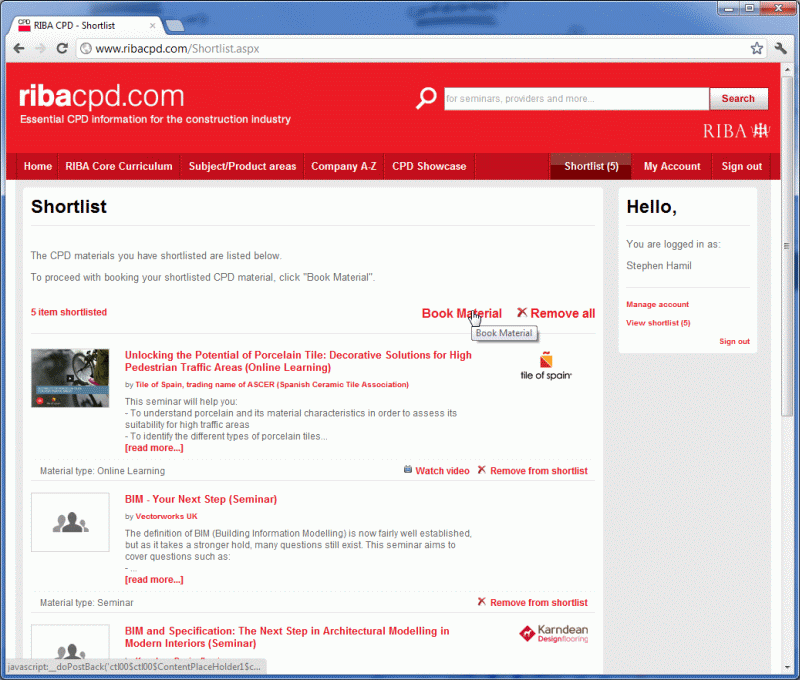
Fig 5 and Fig 6 show this process again for the basket/shortlist area of the site...
Fig 5 - Another example of concept designs - this time for the "basket"
Fig 6 - And the finished product - note that the "basket" changed to "shortlist"
And finally throughout this process requirements, designs and software are put to our Advisory Panel, Beta Testers and other user groups for their feedback. The picture below shows QA Manager Clair Hillier and Head of Specification Ian Chapman hosting a break-out group from our Advisory Panel.
User feedback


Tuesday, 20 March 2012

ecobuild 2012 - Day One

In terms of RIBA Enterprises activities today...

1. NBS National BIM Report
This morning I presented the findings of our National BIM Research. This report is the findings from the most comprehensive and accurate research into UK BIM.

If you haven't already read the report, then I'd definitely recommend it. Some really insightful findings and trends and also some excellent articles and comment pieces from the likes of David Philp (UK Cabinet Office) and Angela Brady (RIBA President).
Fig 1 - By the end of 2011 almost a third of construction professionals are using BIM on at least some projects.

The report also includes an excellent case study from small practice David Miller Architects. In addition to the message that is often reported "you must use BIM by 2016". It's quite nice to also have an article that discusses "what's in it for me" - this case study shows the benefits of BIM in terms of hard-nosed return on investment for a company that has adopted this new process/technology.
Fig 2 - Chart above shows the rise in fee income against investment in BIM.

The final part of the presentation looked at "what is BIM?". The fundamentals of software + people + process cannot be argued with. But it's also fair to say that under-pinning all of this is information. And this is not just the 3D geometry that allows for visualisations and clash detection. The 3D geometry must be coordinated and linked to the specification, guidance, standards, regulations, potential manufacturers and cost (financial and environmental).

Fig 3 - What is BIM?

2. RIBACPD.com
This afternoon, Head of Sales from RIBA Enterprises Ben Councell launched the fantastic new website RIBACPD.com. To date the RIBA Providers Network CPD, the online CPD videos and the RIBA CPD activities have been dispersed across a number of quite disjointed websites. This new site provides essential CPD information for the construction industry all in one portal.
Fig 4 - Watch CPD videos at your desk, answer questions and receive the certificate

Fig 5 - Search for CPD on any topic and then filter the results to suit the way you prefer to learn

Fig 6 - Learn about the CPD events organised by RIBA around the country

3. Construction Information Service v4
And to round off a pretty full day, RIBA Enterprises Software Development Director Dr John Henderson launched version 4 of the Construction Information Service (CIS). CIS is joint venture product from NBS and IHS that gives instant full text access to the latest regulations, standards and technical advice.

Improvements to this release includes improved a completely rewritten search engine, intelligent drop down suggestions, more clearly presented search results and the ability to filter the search results to quickly find the document that is needed. 
Fig 7 - Screenshot showing the new CIS site with the optimised search features

So a busy, busy day. Come and see us tomorrow for some more great stuff on stands S1630 and S1640:
http://www.thenbs.com/topics/Environment/articles/biteSized.asp